The Best Everyday EV Charging Strategy: Cheaper, Healthier, Simpler
6 min read · Updated 8 September 2026
The best charging strategy is the one that costs the least, keeps your battery healthy and takes the least thought. Here is a routine that does all three.
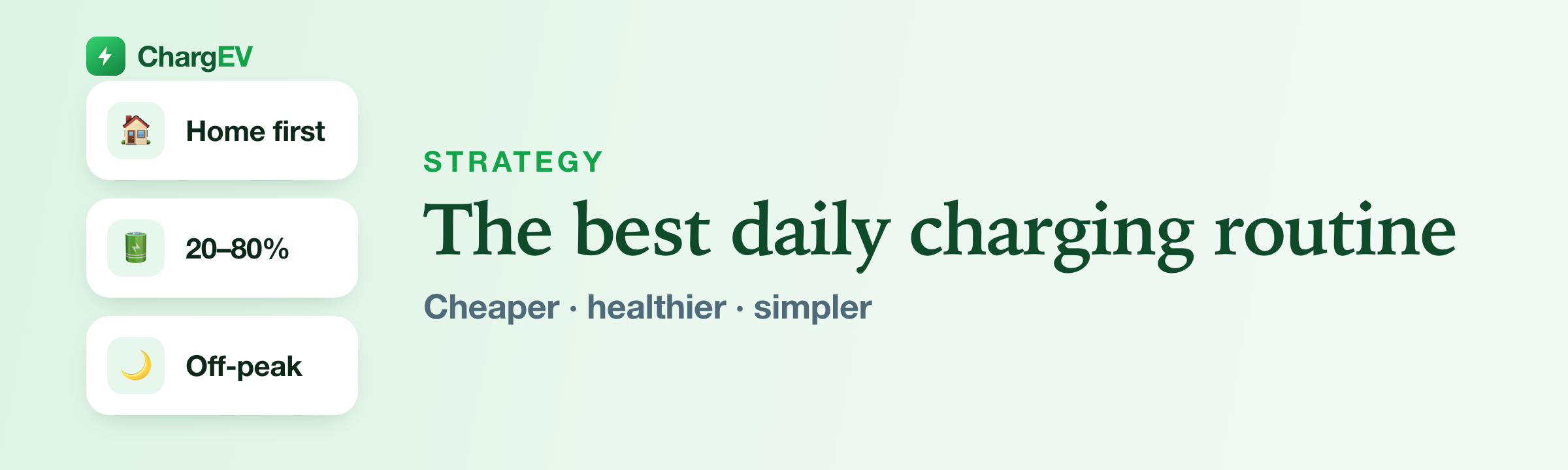
Change the mental model: top up, don't fill up
Petrol drivers run the tank down and fill it up. EV driving works the other way round: you plug in wherever you are parked for a while and leave with more than you arrived with. Most owners with home or workplace charging never 'go to charge' at all — the car is simply full enough every morning. Public fast charging becomes something you do on long trips, not weekly.
The daily routine
- Set the car's charge limit to 80% (or the level the manufacturer recommends — many LFP-battery cars are happy at 100%).
- Plug in at home every evening, or whenever it is convenient; there is no need to wait for the battery to run down.
- Schedule charging for your cheapest tariff window (usually overnight) in the car or charger app; the car will start and stop itself.
- Before a long trip, raise the limit to 100% and let it finish just before you leave.
- On the road, fast-charge from around 10–20% up to 60–80%, which is the fastest part of the curve, then move on.
Why 20–80%
Lithium batteries age fastest when held at very high or very low charge, and charge fastest in the middle of their range. Keeping daily use between roughly 20% and 80% reduces stress on the cells and makes fast-charging stops shorter, because the last 20% is slow. The car's buffer means '0%' on the display is not truly empty, but you should still avoid running it right down regularly.
Choosing where to charge
| Situation | Best choice | Why |
|---|---|---|
| Daily driving with home charging | Home AC, overnight, off-peak | Cheapest, easiest, kindest to the battery |
| No home charging | Workplace or a regular destination AC charger | Cheaper and slower than DC; fits around parking you already do |
| Weekly shop, gym, cinema | Destination AC charger | Free or cheap top-ups while you are busy anyway |
| Long trip | DC fast charger, 10–80% | Speed matters; keep stops short |
| Emergency low battery | Nearest working charger of any type | Use the live map to avoid a dead one |
Don't overthink it
Modern EVs manage their batteries very well. Following the routine above will keep your battery in excellent shape for many years, but an occasional 100% charge, a run down to 5% or a week of fast charging on holiday will not do any harm. The goal is good habits, not anxiety.
Frequently asked questions
Should I charge my EV every night?
If you have home charging, yes — plugging in nightly to an 80% limit is convenient and good for the battery. There is no benefit in waiting for it to run down.
Is it better to charge slowly or fast?
Slow AC charging is cheaper and slightly gentler on the battery, so use it for daily charging and keep DC fast charging for trips.
Find a charger now
Open the free ChargEV map to see EV charging stations near you with live slot status, connectors and pricing — worldwide, and it works offline.
Open the live mapKeep reading
How to Charge Your EV for Maximum Battery Life
Simple, evidence-based charging habits that keep an EV battery healthy for years — the 20–80% rule, when to use rapid charging, heat, and long-term storage.
How Much Does It Cost to Charge an Electric Car?
How EV charging is priced, a simple way to work out the cost of a full charge, and why home charging is usually far cheaper than public rapid charging or petrol.
DC Fast Charging: When to Use It and When Not To
How DC fast charging works, why it slows down above 80%, its effect on battery life, when it is the right choice and when a slower charger is faster, cheaper or kinder overall.
Educational guidance only; details vary by vehicle, operator and country — always check your car’s manual and confirm prices and availability at the station. Station data on ChargEV comes from Open Charge Map, OpenStreetMap and other open sources.