What Happens to EV Batteries at End of Life? Recycling & Second Life
6 min read · Updated 8 September 2026
An EV battery doesn't die when the car does. Most get a second job, and then the metals inside are recovered and used again.
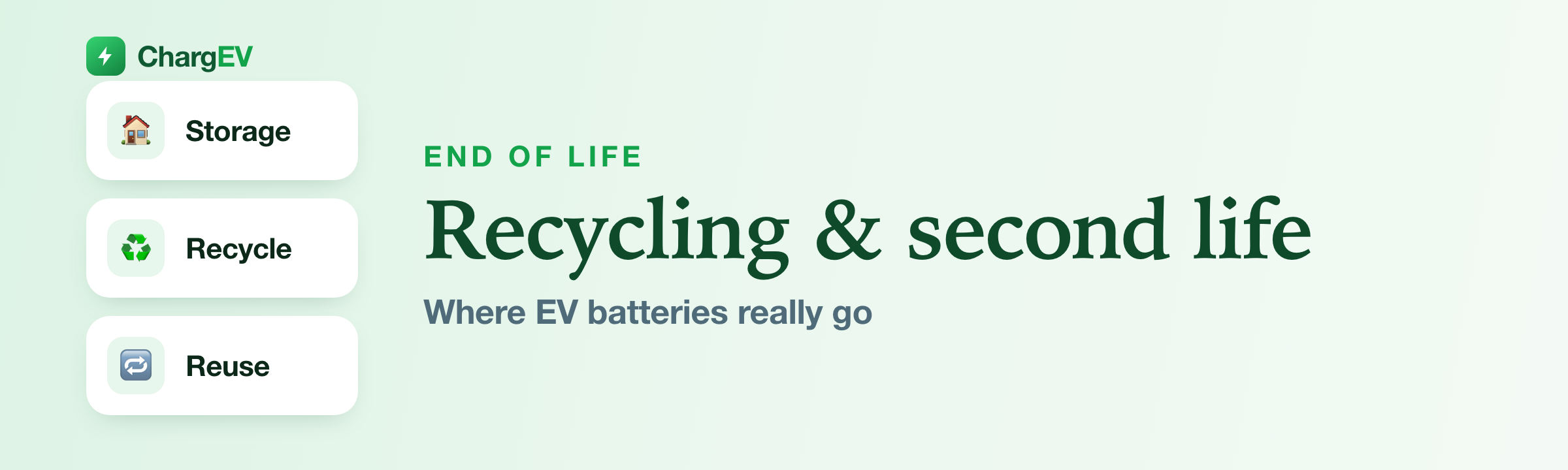
A common worry is that millions of EV batteries will pile up as toxic waste. In practice the opposite is happening: because a used battery pack is full of valuable metals, there is a strong commercial reason to reuse and recycle it, and laws in the EU, China, India and elsewhere now require it.
Stage 1: a long first life
Batteries degrade slowly. Most retain 70–80% of their capacity after 8–10 years and 150,000–250,000 km, and many cars are simply driven on with a slightly shorter range. Manufacturers' warranties typically guarantee at least 70% capacity for 8 years.
Stage 2: second life as stationary storage
A pack that is 'tired' for a car — say 70% capacity — is still excellent for stationary storage, where weight and space matter far less. Used EV packs are being repurposed as home batteries, backup power for buildings, buffers for fast-charging stations and grid-scale storage that soaks up surplus solar and wind. This can add another 5–10 years of useful service before recycling.
Stage 3: recycling
At true end of life the pack is discharged, dismantled and the cells shredded into a 'black mass' from which lithium, nickel, cobalt, manganese and copper are recovered. Two main processes exist: pyrometallurgy (smelting) and hydrometallurgy (chemical leaching), and modern hydrometallurgical plants report recovery rates above 90% for the key metals. Recycled material is then made into new cathode powder, closing the loop and reducing the need for new mining.
| Region | Rule |
|---|---|
| European Union | Battery Regulation: mandatory collection, minimum recycled-content targets rising over time, and a digital 'battery passport' |
| China | Producers responsible for take-back and traceability of EV batteries |
| India | Battery Waste Management Rules place extended producer responsibility on makers and set recovery targets |
| United States | State-level rules plus federal funding for recycling plants; landfilling lithium packs is widely prohibited |
You should never dispose of an EV or e-scooter battery yourself. Dealers, manufacturers and licensed recyclers are obliged to take them back, and damaged packs need specialist handling.
Frequently asked questions
Can EV batteries be fully recycled?
The main metals — lithium, nickel, cobalt, copper and manganese — can be recovered at high rates in modern plants. Some components such as the electrolyte and plastics are harder, so 'close to fully' is more accurate than 'completely'.
Is a second-life battery safe in a home?
Yes when it has been tested, re-certified and installed by a professional with a proper battery management system, exactly like a new home battery.
Find a charger now
Open the free ChargEV map to see EV charging stations near you with live slot status, connectors and pricing — worldwide, and it works offline.
Open the live mapKeep reading
The Carbon Footprint of Making an EV (and Its Battery)
How much CO₂ it takes to build an electric car, why the battery is the big number, how it compares with a petrol car, and what carmakers and buyers can do to shrink it.
How an EV Battery Is Made: From Minerals to a Finished Pack
A step-by-step tour of how a lithium-ion EV battery is made — the raw materials, the cell chemistry, cell and module assembly, the battery management system and testing.
How to Charge Your EV for Maximum Battery Life
Simple, evidence-based charging habits that keep an EV battery healthy for years — the 20–80% rule, when to use rapid charging, heat, and long-term storage.
Educational guidance only; details vary by vehicle, operator and country — always check your car’s manual and confirm prices and availability at the station. Station data on ChargEV comes from Open Charge Map, OpenStreetMap and other open sources.