Do Electric Cars Really Reduce Emissions? The Full Lifecycle Answer
7 min read · Updated 8 September 2026
Critics say an EV just moves the pollution from the tailpipe to the power station. The real picture, once you add up the whole life of the car, is much clearer — and much better for the EV.
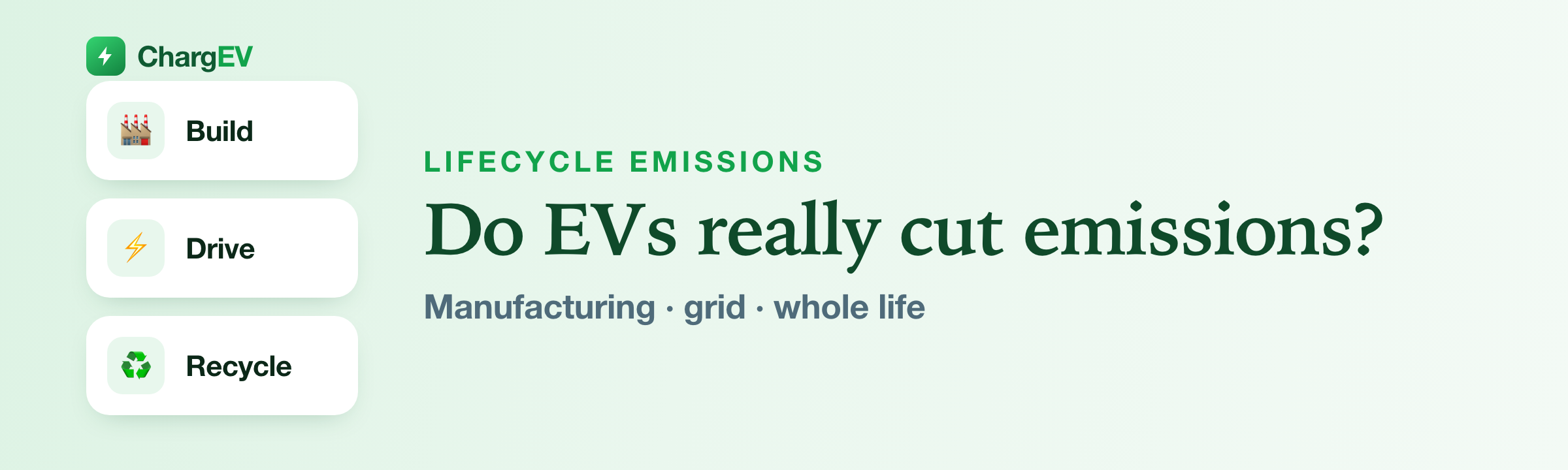
The only fair way to compare an electric car with a petrol or diesel car is over the whole life of both: building them, fuelling them for years, and scrapping them at the end. This is called a lifecycle assessment. When independent bodies run those numbers, an electric car comes out with far lower total greenhouse-gas emissions than a comparable combustion car in almost every country — typically 30–70% lower, depending mainly on how clean the local electricity is.
Where an EV's emissions come from
- Manufacturing — building an EV, and especially its battery, releases more CO₂ than building a petrol car. This is the EV's 'carbon debt' at the start of its life.
- Use — charging draws electricity, and the emissions from that depend on the grid. On a coal-heavy grid the per-km emissions are higher; on a hydro, wind, solar or nuclear-rich grid they are close to zero.
- End of life — recycling recovers most of the metals in a battery, which offsets some of the original manufacturing footprint.
A petrol car, by contrast, has a smaller manufacturing footprint but then burns fuel every single day. Extracting, refining and transporting that fuel adds roughly 20–30% on top of what comes out of the exhaust. Over 150,000–200,000 km, the fuel dominates everything else.
Paying back the carbon debt
Because of the battery, an EV starts life a few tonnes of CO₂ 'behind' a petrol car. It then catches up every kilometre it drives on cleaner energy. On an average European or North American grid the crossover point is typically reached within one to two years of normal driving — roughly 15,000–30,000 km. On a very clean grid it can be under a year; on a heavily coal-dependent grid it can take several years, but the EV still wins over its lifetime.
| Grid type (example) | Rough lifetime saving vs petrol car |
|---|---|
| Very clean (Norway, Iceland, Quebec) | 70% or more |
| Mixed, decarbonising (UK, EU average, California) | 50–70% |
| Average fossil-heavy mix (much of the US, India today) | 30–50% |
| Almost entirely coal | Smaller but still positive; improves every year |
The key point most comparisons miss: a petrol car's emissions are locked in for life, while an EV gets cleaner every year as the grid it charges from adds more renewables.
How to make your EV even cleaner
- Charge when renewables are abundant — often overnight or midday, depending on your region; many tariffs and apps show the grid's carbon intensity by the hour.
- Charge from home solar where you can.
- Choose a green electricity tariff.
- Keep the car longer — the manufacturing footprint is spread over more kilometres.
- Pick a battery size you actually need; a modest pack has a smaller footprint than a huge one you rarely use.
Frequently asked questions
Is an EV cleaner even if my electricity comes from coal?
Usually yes over the car's lifetime, because an electric motor converts energy to motion far more efficiently than a combustion engine, and power stations are more efficient than millions of small engines. The saving is smaller on a coal grid and grows as that grid cleans up.
How many kilometres before an EV is cleaner than a petrol car?
Typically 15,000–30,000 km on an average grid, i.e. one to two years of normal driving. It can be far less on a clean grid.
Doesn't building the battery cancel out the benefit?
No. The battery does create a larger upfront footprint, but it is repaid within the first couple of years and the EV keeps saving emissions for the rest of its life.
Find a charger now
Open the free ChargEV map to see EV charging stations near you with live slot status, connectors and pricing — worldwide, and it works offline.
Open the live mapKeep reading
The Carbon Footprint of Making an EV (and Its Battery)
How much CO₂ it takes to build an electric car, why the battery is the big number, how it compares with a petrol car, and what carmakers and buyers can do to shrink it.
Charging Your EV with Renewable Energy: Solar, Green Tariffs & Timing
Practical ways to make your EV charging genuinely clean — home solar, green electricity tariffs, charging when the grid is greenest and smart chargers that do it for you.
Benefits of Owning an EV: Environment, Cost & Efficiency
The real benefits of switching to an electric vehicle — lower emissions, big running-cost savings, far higher efficiency, less maintenance and a quieter, smoother drive.
Educational guidance only; details vary by vehicle, operator and country — always check your car’s manual and confirm prices and availability at the station. Station data on ChargEV comes from Open Charge Map, OpenStreetMap and other open sources.