Vehicle-to-Grid (V2G) and Vehicle-to-Home Explained
6 min read · Updated 8 September 2026
Your EV's battery is one of the biggest energy stores you own. Bidirectional charging lets it work for you when the car is parked — which is most of the time.
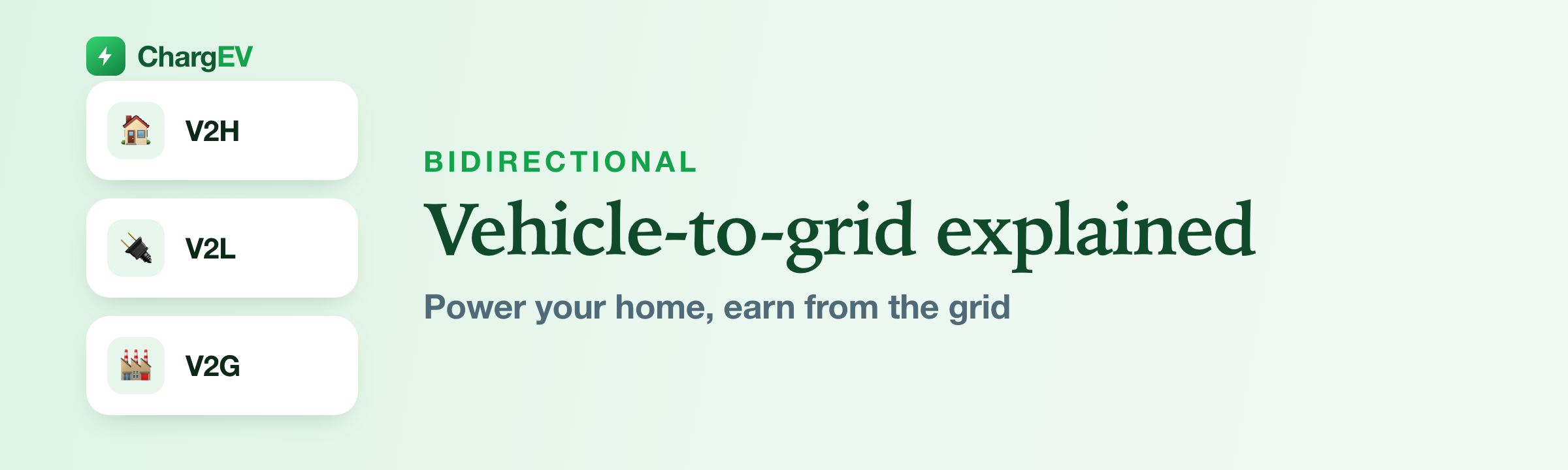
A typical EV battery holds 50–80 kWh — several days' worth of an average home's electricity. Bidirectional charging lets that energy flow out of the car as well as in. There are three flavours, and the letters matter.
| Term | What it does | Needs |
|---|---|---|
| V2L (vehicle-to-load) | A power socket on the car runs appliances, tools or camping gear | A car with V2L; no special charger |
| V2H (vehicle-to-home) | The car powers your house, e.g. during a blackout or the evening peak | A bidirectional home charger and compatible car |
| V2G (vehicle-to-grid) | The car exports power to the grid when it is most valuable and is paid for it | Bidirectional charger, compatible car and a V2G tariff or aggregator |
Why it matters for renewables
Wind and solar generation rises and falls, and the grid needs storage to smooth it out. Millions of parked EVs add up to an enormous distributed battery. Charging when there is surplus renewable power and discharging a little at the evening peak lets the grid use more clean energy and fewer gas 'peaker' plants. Trials in the UK, Netherlands, Japan and Australia have paid participating drivers hundreds of pounds or dollars a year.
Does it damage the battery?
This is the most common worry. Studies so far suggest that well-managed V2G — shallow, controlled cycles within the middle of the battery's charge range — adds very little degradation, and some research suggests smart management can even reduce it compared with leaving a car sitting at 100% for days. Manufacturers that support V2G cover it under warranty; a car that does not officially support it should not be used with a bidirectional charger.
What you need
- A car that supports bidirectional charging (increasingly common on new models — check the spec sheet for V2L, V2H or V2G).
- A bidirectional home charger, which costs more than a standard wallbox.
- For V2G, an electricity tariff or aggregator that pays for exports, and grid rules that allow it in your country.
- The car parked and plugged in during the hours the grid wants power — usually the evening peak.
Even without V2G, V2L is a genuinely useful feature: running a fridge in a power cut, powering tools at a site, or a kettle at a campsite from the car.
Frequently asked questions
Can any EV do vehicle-to-grid?
No — the car, the charger and local regulations all need to support it. Check the car's specification for V2H or V2G before buying a bidirectional charger.
How much can I earn from V2G?
Trials have reported roughly a few hundred pounds, dollars or euros a year, depending on tariff, how often the car is plugged in and how much energy you allow it to export.
Find a charger now
Open the free ChargEV map to see EV charging stations near you with live slot status, connectors and pricing — worldwide, and it works offline.
Open the live mapKeep reading
Charging Your EV with Renewable Energy: Solar, Green Tariffs & Timing
Practical ways to make your EV charging genuinely clean — home solar, green electricity tariffs, charging when the grid is greenest and smart chargers that do it for you.
Charging an EV at Home: Chargers, Costs & Setup
A practical guide to home EV charging — plug-in vs wallbox, how long it takes, what it costs, electrical requirements, and how to charge cheaply overnight.
How to Charge Your EV for Maximum Battery Life
Simple, evidence-based charging habits that keep an EV battery healthy for years — the 20–80% rule, when to use rapid charging, heat, and long-term storage.
Educational guidance only; details vary by vehicle, operator and country — always check your car’s manual and confirm prices and availability at the station. Station data on ChargEV comes from Open Charge Map, OpenStreetMap and other open sources.